
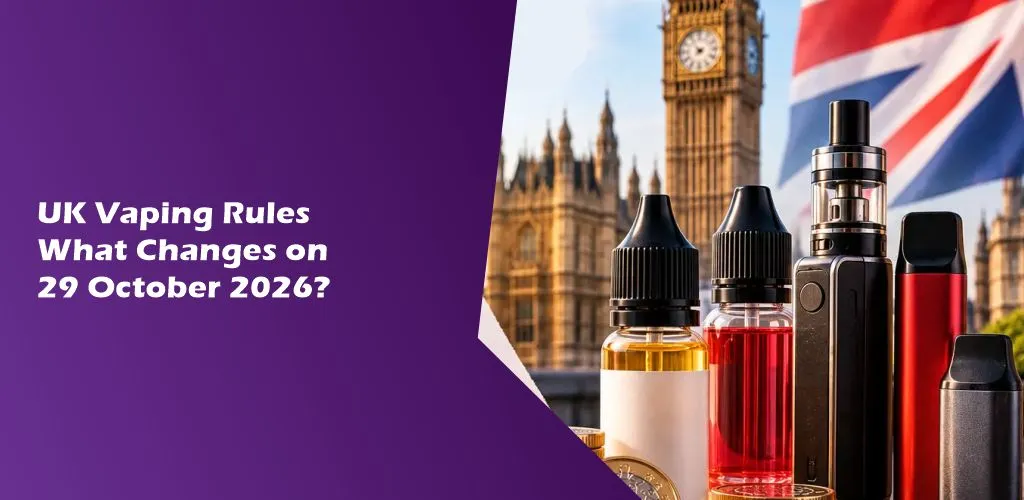
On 29 October 2026, UK vaping rules tighten for anyone who sells, supplies or buys vaping and nicotine products. Retailers face new offences, wholesalers need to brief their customers, and adult consumers will notice changes at the till and in promotions.
The short answer: from 29 October 2026, official DHSC guidance confirms that the age of sale for all vaping and nicotine products is 18 across the UK. Buying or attempting to buy these products for someone under 18 becomes an offence. Giving them away for promotional purposes, selling them at a substantial promotional discount, and handing out promotional coupons also become offences. A separate vending machine ban starts on the same day.
The rules come from the Tobacco and Vapes Act 2026, which received Royal Assent on 29 April 2026, and from matching legislation in Scotland and Northern Ireland. Other vaping measures follow different timetables, and this guide separates them so you know which UK vaping regulations apply now and which apply later. You will learn what changes, who it affects, what retailers should do first, and what adult consumers can expect.
This article is general information, not legal advice. Check the linked GOV.UK pages for updates before you act.
What UK Vaping Rules Change on 29 October 2026?
Six changes take effect on 29 October 2026. Together they form the core of the new vape laws UK businesses must follow in 2026:
- It is an offence to sell vaping or nicotine products to anyone under 18.
- It is an offence for an adult to buy, or try to buy, these products for someone under 18.
- It is an offence to give away these products where the purpose or effect is to promote them.
- It is an offence to sell them at a substantial discount where the purpose or effect is to promote them.
- It is an offence to give or sell at a substantial discount a coupon for these products where the purpose or effect is promotional.
- Vending machines that sell or dispense these products are banned from premises.
The guidance applies to England, Wales, Scotland and Northern Ireland, but each nation uses its own legislation. The Tobacco and Vapes Act 2026 covers England and Wales, the Tobacco and Primary Medical Services (Scotland) Act 2010 covers Scotland, and the Health and Personal Social Services (Northern Ireland) Order 1978 covers Northern Ireland. Penalties can differ between nations, so this guide flags the differences that matter.
Which products do the new rules cover?
The rules cover vaping products and nicotine products. Vaping products include vape devices such as pens, substances to be vaped such as e-liquid, and related components such as coils and pods. Nicotine products include nicotine pouches, strips and pearls. All types of nicotine count, including synthetic nicotine made in a laboratory.
The guidance excludes batteries, charging devices and electrical leads, which fall under wider consumer protection and safety law. It also excludes medical devices and medicinal products.
So do the new rules apply to vape liquid? Yes. E-liquid is a named example of a vaping product, which means e-liquid rules UK retailers follow now sit alongside these new offences. Shoppers who browse the Vaping Products range at KLiquid, or any other retailer, will meet the same age and promotion rules. KLiquid’s range of vape liquid falls within the vaping products definition like any other e-liquid.
Is the Legal Age to Buy Vapes Changing, and Can an Adult Buy for Someone Under 18?
The legal age to buy vapes in the UK stays at 18. What changes is the scope. In England, Wales and Northern Ireland, the earlier age restriction applied only to nicotine vaping products. From 29 October 2026, it covers all vaping products, so non-nicotine vapes come within the vape age restrictions UK retailers must apply. Scotland already restricted both nicotine and non-nicotine vapes, and its rules now extend to nicotine products.
An adult cannot lawfully buy a vape for someone under 18. The proxy purchasing offence applies to anyone aged 18 or over who buys, or attempts to buy, a vaping or nicotine product on behalf of a person under 18. The adult who makes the purchase commits that offence. England, Wales and Northern Ireland previously applied it only to nicotine vaping products, and Scotland extends its existing rules to nicotine products.
What does the age-of-sale offence mean for retailers?
The offence applies to retail sales, including online retailers. A retailer must be satisfied that a customer is 18 or over before completing a sale, and a customer who cannot prove their age should expect a refused sale.
For England, Wales and Northern Ireland, regulations will set out the age verification steps that give retailers a statutory defence. DHSC says Parliament will debate those regulations in due course and that it will update its guidance. Retailers also have a defence if they prove they took all reasonable steps to avoid the offence. In Scotland, retailers must already operate an age verification policy for vapes and must extend it to nicotine products from 29 October 2026. Scottish legislation lists the accepted forms of identification.
Penalties start with a fixed penalty notice of £200 in England, Wales and Scotland. In Northern Ireland, the guidance gives £250, subject to Northern Ireland Assembly approval. Enforcement bodies can instead pursue a larger fine on conviction. The legislation is section 10 of the Tobacco and Vapes Act 2026 for age of sale and section 11 for proxy purchasing.
Do the rules apply to wholesale sales?
No. The age-of-sale restriction covers retail sales only. It does not cover business-to-business sales or sales to an organisation. A person under 18 working in a retail business can still buy stock from a wholesaler for the business, but a retailer cannot sell to a person under 18 for personal use. Scotland adds a rule that an under-18 member of staff needs written authorisation from the registered person for the premises before selling these products.
Are Vape Vending Machines Being Banned in the UK?
Yes. From 29 October 2026, a person with management or control of premises commits an offence if the premises contain a vending machine from which customers can buy vaping products, nicotine products, tobacco products, herbal smoking products or cigarette papers. The ban also covers machines that dispense these products as part of a sale, even when payment happens elsewhere. The vape vending machine ban builds on existing rules, because the UK already bans tobacco vending machines and Scotland already bans vaping product vending machines. The relevant law is section 12 of the Tobacco and Vapes Act 2026 for vaping and nicotine products in England and Wales.
Who is responsible, and what exceptions apply?
The person managing or controlling the premises carries responsibility. The machine owner does not, unless they also control the premises. A premises manager who wants to remove a machine should contact the owner or operator to agree arrangements.
Two points matter in practice:
- Storage is allowed. A vending machine can serve as secure storage if it does not sell or dispense products to customers. A machine that dispenses stock to a staff member, who then handles the sale to a customer, is also permitted.
- One exception exists in England and Wales. Vaping product vending machines may continue in areas of adult mental health hospitals intended wholly or mainly for inpatients. The exception does not cover Scotland, Northern Ireland or other clinical settings.
A vending machine offence carries a fine on summary conviction of up to £2,500 in England, Wales and Scotland and up to £5,000 in Northern Ireland. Scotland and Northern Ireland also use fixed penalty notices. Local trading standards enforce the ban in England, Wales and Scotland, and local councils enforce it in Northern Ireland.
Can Vape Shops Still Offer Discounts and Free Giveaways?
Vape shops can still run ordinary discounts, but they cannot give away vaping or nicotine products to promote them. The new vape promotional discount rules target promotion, not every price cut. The offences apply only where the purpose or effect is to promote the product, so context matters.
Are free vape giveaways allowed after 29 October 2026?
Not when the giveaway promotes the product. The free vape giveaway rules prohibit giving a vaping or nicotine product, or a coupon, to a member of the public where the purpose or effect is promotional. DHSC’s examples of offences include giving away refillable pods as a free gift and handing customers free samples to try. The ban applies in store, online and through third-party promotions.
The rule also reaches items that promote a vaping product without being one. A branded vape charger is the guidance’s example. A coupon means anything redeemable for a product, service, cash or another benefit, whether physical or electronic.
One defence exists. A retailer working under a formal contract with a public authority, such as a local stop smoking service, can supply products or coupons within the scope of that agreement. Section 15 of the Tobacco and Vapes Act 2026 covers free distribution and substantial discounts in England and Wales.
Will vape shops still be able to offer discounts?
Yes, within limits. DHSC describes a substantial discount as a price cut that significantly lowers the cost of a product against its standard selling price. Whether a discount counts as substantial depends on the product and the type of promotion. The ban exists to stop businesses circumventing the free distribution offence, and the guidance says selling e-liquid, devices or nicotine products for a nominal sum such as 10p would likely be an offence.
The guidance states that normal discounting practices stay lawful. Retailers can still sell unsold stock at a reduced price, and bulk and trade discounts may still apply. Retailers must also keep following the existing advertising and promotion rules in Part 7 of the Tobacco and Related Products Regulations 2016 until the Tobacco and Vapes Act 2026 replaces them.
Penalties for these offences are more serious than for age-of-sale offences, and they differ by nation. In England and Wales, conviction can bring a fine or imprisonment, and the Crown Court can impose unlimited fines and up to two years in prison. Scotland and Northern Ireland set different limits, so check the DHSC guidance for your nation.
How Should Vape Retailers and Suppliers Prepare?
Vape retailer compliance in 2026 starts with the six offences above. Legal requirements come from the legislation and guidance. The steps below combine those requirements with practical recommendations, and the recommendations are not legal duties.
For retailers and vape shop operators:
- Review age verification procedures. Confirm that every till, online checkout and delivery process checks age before sale. Many UK retailers use a “Challenge 25” style approach, which is common practice and not a legal requirement.
- Train staff on age-of-sale rules. Cover the extended product scope, including non-nicotine vapes in England, Wales and Northern Ireland and nicotine products everywhere.
- Set a procedure for suspected proxy purchases. DHSC says staff who suspect one should refuse the sale.
- Audit promotions. Check free samples, gift-with-purchase offers, emailed codes, loyalty rewards and discounts against the rules on free distribution, substantial discounts and coupons, including branded merchandise.
- Check for vending machines. Remove them, or move them to an area customers cannot reach and use them for storage only.
- Keep records. Written procedures and training logs help show that you took reasonable steps.
- Watch for updated guidance. The age verification regulations for England, Wales and Northern Ireland are still to come.
- Understand the escalation risk. In England and Wales, three relevant offences within two years can lead to a restricted sale order or restricted premises order lasting up to 12 months. Scotland and Northern Ireland have their own versions.
For wholesalers and suppliers: the age-of-sale rule does not apply to trade sales, and the guidance does not impose a duty on wholesalers to police their customers’ promotions. Even so, brief your retail customers on the changes, review your own promotional offers to trade and public customers, and point them to official guidance. Suppliers that run consumer-facing promotions should audit them against the free distribution and discount offences.
What Should Adult Consumers Know, and Which Vaping Rules Start Later?
Adult vaping consumers can still buy and use vaping products lawfully after 29 October 2026. Nothing in these changes makes ordinary adult possession or use unlawful, and these vaping law changes in October 2026 do not ban vaping products. Adults should expect age checks and may see fewer free samples, giveaway gifts and deep promotional price cuts. Retailers can still run ordinary sales and bulk offers.
An adult who buys on behalf of someone under 18 commits a proxy purchasing offence, so passing a vape to a younger friend or relative after buying it carries legal risk.
Which vaping regulations are already in force, and which start later?
Not every vaping provision starts on 29 October 2026. This table keeps them apart:
| Measure | Status |
| Single-use (disposable) vape ban | In force since 1 June 2025 across the UK |
| Vaping Products Duty, £2.20 per 10ml, and vaping duty stamps | Started 1 October 2026, with a transition period for stock already in the market until 1 April 2027 |
| Age of sale, proxy purchasing, free distribution, substantial discounts, coupons, vending machines | Start 29 October 2026 |
| Retail licensing, flavour, packaging and display rules | The Act creates powers, but timing and details are still awaited, and a consultation on packaging, appearance and display runs to October 2026 |
| Advertising and sponsorship ban for vapes and nicotine products | Government has indicated a start date of 1 June 2027, according to legal commentary, and it is not yet in force |
The Act’s rolling tobacco age-of-sale rules follow their own timetable and concern tobacco, not vaping products. Treat each date separately and check GOV.UK’s vaping duty guidance for tax and stamp requirements.
Do the same rules apply across the UK?
The core changes apply in all four nations, but the legal source, penalties and some details differ. Scotland already has age verification policy requirements and a banning-order system, Northern Ireland uses different fine levels, and the mental health hospital vending exception applies only in England and Wales. Businesses operating in more than one nation should check each set of provisions.
Final Thoughts on UK Vaping Regulations in 2026
The changes on 29 October 2026 centre on protecting under-18s and limiting promotion. The age remains 18, but the scope widens to every vaping and nicotine product. Proxy purchasing becomes an offence. Giveaways, substantial promotional discounts and promotional coupons fall under new offences. Vending machines are banned, except in adult mental health inpatient areas in England and Wales. Ordinary discounting and adult use remain lawful. Retailers that audit their age checks, staff training, promotions and machines now will be best placed when the date arrives.
For adult readers who want product information, KLiquid publishes details of its vape liquid, devices and accessories on its website. Buying from any supplier does not by itself ensure legal compliance, so check official guidance on GOV.UK for your own situation. Adults who want to see what KLiquid stocks can browse the KLiquid website or contact the team through the site.