
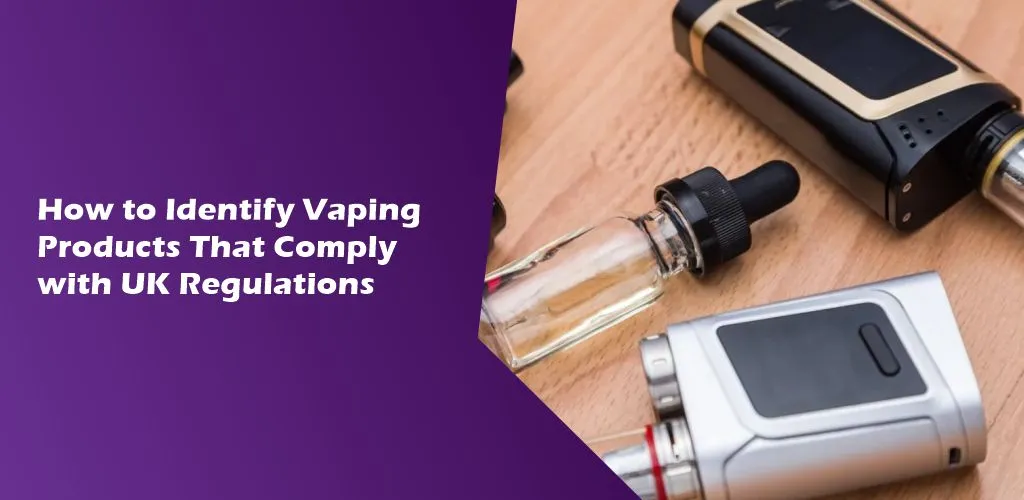
A vape can look professional on the shelf and still break the law. Since June 2025, UK vaping regulations have changed in four major ways: the single-use vape ban, the Tobacco and Vapes Act 2026, Vaping Products Duty with duty stamps, and new age-of-sale rules. Each change adds a check that packaging alone cannot answer.
Vaping product compliance UK rules protect adult consumers and carry real consequences for businesses. Trading Standards can seize non-compliant stock, and continued sales of single-use vapes in England can lead to an unlimited fine or up to two years in prison.
The challenge is that proof of compliance sits in several places. The label shows some evidence, the MHRA published list shows more, HMRC’s duty stamp covers the tax, and the product’s design decides whether the law treats it as reusable. No single mark proves everything.
This guide explains how to identify compliant vaping products in the UK. You will learn which laws apply to nicotine and nicotine-free products, how to check labels and MHRA notification, which products the law restricts or prohibits, and what retailers and wholesale buyers should verify before they buy. The guide separates law in force today from proposals that remain under consultation. We wrote it for UK vape retailers, wholesalers, distributors, trade buyers and adult consumers aged 18 and over.
Nicotine is highly addictive and vaping is not risk free. Adults who do not smoke or use nicotine should not start, and this guide does not replace legal advice.
What Regulations Must Vaping Products Meet Under UK Vaping Regulations?
Nicotine vapes must meet the Tobacco and Related Products Regulations 2016 (TRPR). Every vape, with or without nicotine, must also meet the single-use ban, Vaping Products Duty rules and age-of-sale law. The category of product decides which UK vape regulations apply.
Nicotine-containing e-liquids and devices
Part 6 of the TRPR governs e-cigarettes and refill containers that contain nicotine. Regulation 36 sets the product limits: nicotine strength up to 20mg/ml, refill containers up to 10ml and tanks up to 2ml. Regulation 37 sets information and labelling duties. The MHRA runs the notification scheme behind these TRPR vaping regulations in Great Britain and Northern Ireland. The limits apply to every product sold to a consumer, even when the buyer plans to modify it.
Nicotine-free vapes and 0mg e-liquids
The TRPR do not cover 0% nicotine e-liquids or nicotine-free vapes. General product safety law covers them instead. They still face the single-use ban, duty and age-of-sale rules, so 0mg does not mean unregulated.
Rules that apply to every vape
- Single-use ban: in force since 1 June 2025, for all vapes whether or not they contain nicotine.
- Waste electrical rules: vapes count as electrical items under the WEEE Regulations, and retailers must offer a take-back service for used vapes and parts.
- Chemical labelling: the Classification, Labelling and Packaging of Chemicals Regulations 2015 apply alongside the TRPR.
- Vaping Products Duty and duty stamps: in force since 1 October 2026.
- Age of sale: 18 for all vaping and nicotine products since 29 October 2026.
Differences across the four nations
The single-use ban took effect on the same day in England, Scotland, Wales and Northern Ireland, but each nation enforces it through its own authorities and penalties, and Wales also has its own regulations. Northern Ireland adds notification through the EU Common Entry Gate. Scotland already restricted sales of non-nicotine vapes to adults and requires retailers to run an age verification policy.
How Can You Check Whether a Vaping Product Complies with UK Regulations?
A vape is legal to sell in the UK when it is reusable, meets the TRPR limits, appears on the MHRA published list if it contains nicotine, carries the required labels and, for new stock, carries a duty stamp. Use this vape compliance checklist to test each product. The last column separates legal requirements from recommended due diligence.
| Check | What to look for | Type | |
| 1 | Reusable design | Rechargeable battery, refillable container (tank, pod or cartridge) and a removable, replaceable coil. Refills and coils on sale separately. | Legal requirement |
| 2 | Nicotine strength | No more than 20mg/ml in any nicotine-containing liquid. | Legal requirement |
| 3 | Container and tank size | Refill bottles up to 10ml. Tanks, cartridges and pods up to 2ml. | Legal requirement |
| 4 | MHRA notification | The nicotine product appears on the MHRA published list under its ECID, brand or submitter name. | Legal requirement |
| 5 | Label and warnings | Health warning, ingredients, nicotine content, batch number and a keep-out-of-reach recommendation. Child-resistant, tamper-evident container. | Legal requirement |
| 6 | Duty stamp | Valid vaping duty stamp on retail packaging for stock made or imported from 1 October 2026. | Legal requirement |
| 7 | Producer and importer identity | The submitter on the MHRA list matches the brand owner or importer on the pack and invoice. | Recommended due diligence |
| 8 | Traceability records | Invoices, ECID numbers, batch numbers and stamp details stored for each delivery. | Recommended due diligence |
| 9 | Supplier documentation | Written confirmation of notification, plus any independent test reports the supplier holds. | Recommended due diligence |
A failed legal check means you refuse the product. A gap in a recommended check means you ask the supplier for evidence before you buy. Packaging appearance alone never establishes compliance, because a convincing box does not prove notification, correct limits or tax status.
What Packaging and Labelling Details Should Compliant Vape Liquid Display?
Compliant nicotine vape liquid carries a health warning on the front and back of the pack, an ingredient list, nicotine content and delivery per dose, a batch number and a recommendation to keep it away from children. The container must resist children and show tampering. These rules cover UK vape packaging regulations for nicotine products under regulation 37 of the TRPR.
Mandatory label elements for nicotine-containing products
- Health warning: “This product contains nicotine which is a highly addictive substance”, in black text on a white background, on the front and back surfaces. Trading Standards guidance puts the warning at 30% of each surface.
- Ingredients: a full list in descending order by weight.
- Nicotine information: nicotine content and delivery per dose.
- Batch number: the identifier that links a bottle to its production run.
- Child safety: a recommendation to keep the product out of reach of children, in a child-resistant, tamper-evident container that resists breakage and leaks.
- Banned content: offers, discounts, and health or safety claims. Packs must not carry any of them.
When the pack cannot hold every detail, an accompanying leaflet must carry the rest.
Labelling differences between product categories
Nicotine-free e-liquids fall outside the TRPR labelling and notification rules, but general product safety and chemical labelling law still applies. Devices and refill containers share the nicotine warning rule when they contain nicotine. From 1 October 2026, new stock also needs a duty stamp on the retail packaging, which adds a fourth layer of evidence beside the label, the MHRA list and the product design.
How to evaluate a label in practice
Read the front and the back, then match the batch number on the outer pack with the number on the bottle. Check the strength against the 20mg/ml limit and the bottle size against the 10ml limit. The K Liquid Classic Tobacco 10ml page, for example, lists a 10ml bottle, 18mg/ml strength, a 70% PG and 30% VG blend and a child-resistant cap. Those figures sit inside the legal limits, but a product page never replaces the MHRA list check. Compare these requirements against the product pages in KLiquid’s vape liquid range.
How Do MHRA Notifications Help Identify Compliant Vaping Products?
The MHRA publishes a list of nicotine vapes and e-liquids that producers have notified successfully. Nicotine products cannot legally reach customers until the MHRA publishes their notification, so the list is the fastest way to test a product’s legal status. This MHRA vape product notification check applies to nicotine-containing products only.
Who must notify
Producers notify. The MHRA defines a producer as anyone who manufactures or imports e-cigarettes or refill containers, or who rebrands them as their own. A retailer that only sells products does not notify, but a retailer that imports or rebrands becomes a producer. Components that touch nicotine liquid need notification. Batteries and mouthpieces do not.
How to check the MHRA list
- Open the ECIG publications list through the MHRA’s GOV.UK guidance, “E-cigarettes: regulations for consumer products”.
- Search by ECID number, submitter name or brand name.
- Match the listed product name, volume and strength to the pack in your hand.
- Record the ECID and the date of your check with the delivery record.
The MHRA withdrew its published single-use vape entries from 1 June 2025, so a product that once appeared on the list may no longer appear.
What notification does not prove
Notification, legal compliance and independent safety testing are three different things.
- Notification shows the producer submitted the required information and the MHRA published it.
- Legal compliance also depends on the label, limits, reusability, duty stamp and age-of-sale rules, and Trading Standards can still act against a listed product that breaks the TRPR.
- Independent safety testing comes from a third-party laboratory. Notification is not a safety endorsement and does not replace testing.
Northern Ireland producers also notify through the EU Common Entry Gate, so Northern Ireland buyers should confirm that route with their supplier.
Which Vaping Products Are Restricted or Prohibited Under UK Law?
UK law bans single-use vapes. Nicotine liquid above 20mg/ml, refill bottles above 10ml and tanks above 2ml do not meet UK vaping product restrictions. Sales of any vape to anyone under 18 are illegal. The sections below separate each rule from the proposals that have not become law.
Disposable vape ban UK (in force since 1 June 2025)
It is illegal for businesses to sell, supply, offer or stock single-use vapes, online or in shops, whether or not the vape contains nicotine. A reusable vape needs a rechargeable battery, a refillable container (tank, pod or cartridge) and a removable, replaceable coil if it has one. Refills and coils must be available to buy separately. Businesses must hold evidence that a product is reusable. In England, Trading Standards starts with civil sanctions such as a stop notice, a compliance notice or a £200 fine, and continued sales can lead to an unlimited fine or up to two years in prison.
TRPR product limits (in force)
The 20mg/ml nicotine strength limit, the 10ml e-liquid bottle size limit and the 2ml vape tank capacity limit apply to every nicotine product sold to consumers. MHRA advice states that squonk devices with a reservoir above 2ml cannot be supplied in the UK, and that plastic plugs which shrink a tank’s capacity do not make a product compliant.
Age of sale and promotion rules (in force since 29 October 2026)
The age of sale for all vaping and nicotine products is now 18 across the UK, including nicotine-free vapes in England, Wales and Northern Ireland. Buying a vape for someone under 18 is an offence. The same date introduced offences for free giveaways and substantial discounts that promote vapes. Trade discounts and bulk pricing remain allowed, and the age rule does not cover business-to-business sales. GOV.UK guidance says further regulations will set out age verification steps for England, Wales and Northern Ireland.
Vaping Products Duty and duty stamps (in force since 1 October 2026)
Vaping Products Duty charges £2.20 per 10ml of vaping liquid, with or without nicotine. Vapes made in or imported into the UK from 1 October 2026 need a duty stamp on the retail packaging. Retailers can sell unstamped stock made or imported before that date until 31 March 2027. From 1 April 2027, every vape outside duty suspension must carry a valid stamp. Transitional stamps could go on products until 31 December 2026, and only digital stamps go on from 1 January 2027.
Proposals that are not yet law
The Tobacco and Vapes Act 2026 received Royal Assent on 29 April 2026. It gives ministers powers to regulate flavours, packaging and display, and it creates a framework for retail licensing. The government consulted from 10 July to 2 October 2026 on plain white vape packaging, flavour descriptions, device colours and out-of-sight displays. Those measures remain proposals. Current TRPR packaging rules stay in force until new regulations replace them, and licensing dates remain unconfirmed.
What Should UK Vape Retailers and Wholesale Buyers Check Before Purchasing Stock?
Before buying stock, check five things: the MHRA publication for nicotine products, the reusable design, the TRPR limits and labels, the duty stamp or its transitional status, and the supplier’s paper trail. These checks form the core of UK vape retail compliance and UK vape wholesale compliance, because retailers share responsibility with producers for every product on the shelf. The same checks apply when you buy vape products wholesale from any UK vape supplier.
Supplier documentation to request
Ask every UK vape supplier and vaping product distributor for the ECID of each nicotine product, written confirmation of notification status and an invoice that names the supplying business. HMRC tells buyers to ask for and keep enough information to prove that stock is legitimate, and to take particular care when a supplier offers unstamped products after 1 October 2026. Ask how the supplier evidences that each device is reusable, including where you can buy refills and coils separately.
Stock verification on delivery
- Match the batch number on the outer carton, the unit pack and the bottle to the invoice.
- Confirm that each retail pack carries a duty stamp, unless the stock predates 1 October 2026.
- Read the health warning, the ingredient list and the strength on a sample from every batch.
- Compare the stated volumes with the 10ml and 2ml limits.
- Reject any device without a rechargeable battery, a refillable container or a replaceable coil.
Keep the results with the delivery record. Trading Standards can ask you to prove that a product is legal and reusable, and your records are that proof. Retailers must also offer a take-back service for used vapes and parts under the WEEE Regulations.
Commercial, regulatory and reputational risk
Non-compliant stock carries three costs. Trading Standards can seize it, so you lose the purchase price and the sale. Unstamped stock becomes unsellable from 1 April 2027. A product that fails a customer’s or an inspector’s check also damages your reputation with the adult consumers who rely on you.
Where KLiquid fits
KLiquid’s range of vaping products includes e-liquids in 10ml bottles and multi-bottle boxes, cartridges, tanks and starter kits. Treat each listing as a starting point and run the same checks on every product, ours included. Ask for the ECID and stamp details before you place a trade order, and use the product pages to compare sizes, strengths and PG/VG ratios against the limits above.
How Can You Choose Vaping Products with Greater Confidence in the UK?
Choose compliant vaping products in the UK by confirming six facts for every product. It is reusable. It stays within the 20mg/ml, 10ml and 2ml limits. It carries the required warnings and batch details. It appears on the MHRA list if it contains nicotine. It carries a duty stamp where one applies. It goes only to buyers aged 18 or over.
Supplier transparency completes the compliance check. A supplier that shares notification details, batch records and stamp status gives you evidence you can keep. A supplier that avoids those questions gives you a reason to look elsewhere. Keep notification, legal compliance and independent safety testing separate in your mind, because passing one never proves the other two.
KLiquid has served the smoking accessories industry for over 25 years, and its shop lists e-liquids, cartridges, tanks and kits with product-page details such as bottle size, strength and PG/VG ratio. Use those details to run the checks in this guide. Learning how to identify compliant vaping products comes down to evidence, not appearance.
Adult readers aged 18 and over and trade buyers can visit kliquid.co.uk to explore KLiquid’s available vaping products and vape liquid range, review each product’s details and make informed purchasing decisions. A visit does not replace your own compliance checks, so confirm MHRA notification, duty stamp status and age-of-sale duties before you buy or sell. Vaping is not risk free, and these products suit adults who already use nicotine.