
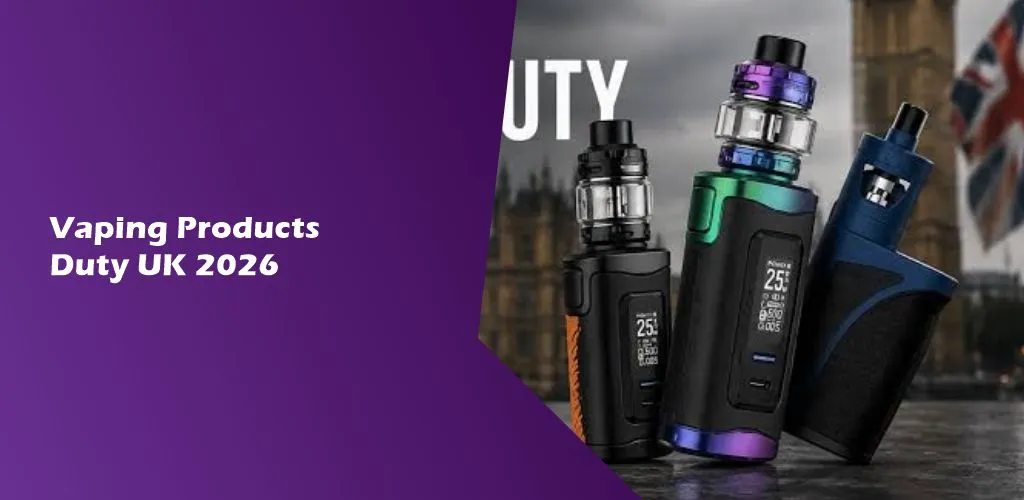
E-liquid prices in the UK are about to change, and the reason is a new tax most vapers have not encountered before. Vaping Products Duty UK 2026 is a flat-rate excise charge on vaping liquid that comes into force on 1 October 2026, and it applies to every bottle of e-liquid sold in the UK, whether it contains nicotine or not. For adult vapers who are used to VAT being the only tax on their vape juice, this is a significant shift in how e-liquid is priced.
This article explains what vaping products duty actually is, when it starts, how it is likely to affect e-liquid prices, which products are covered, and what UK adult consumers should know before they next restock. Confirmed government information is clearly separated from industry estimates and commentary throughout, so you can see exactly what is fact and what is still developing.
What Is Vaping Products Duty UK 2026?
Vaping Products Duty (VPD) is a new UK excise duty charged on vaping liquid. It was announced at Autumn Budget 2024 and forms part of the Tobacco and Vapes Act, the same piece of legislation behind wider restrictions on youth vaping and tobacco control. The duty sits alongside VAT rather than replacing it, meaning e-liquid will carry two separate charges once it takes effect: the new excise duty and the existing 20% VAT.
The rate has been confirmed by HM Revenue and Customs (HMRC) as £2.20 per 10ml of vaping liquid, which works out at 22 pence per millilitre. Crucially, this is a flat rate. It does not vary by nicotine strength, so a 0mg nicotine-free shortfill, a 3mg freebase e-liquid and a 20mg nic salt are all taxed in exactly the same way, based purely on volume.
Why Is the UK Introducing Vaping Products Duty?
The government has framed the duty as part of a broader public health strategy to reduce youth vaping and support its wider smoke-free ambitions. Tobacco duty is rising alongside vaping products duty, and the stated aim is to preserve a clear price gap between vaping and smoking, so that vaping remains the cheaper option for adult smokers looking to quit, while making vaping less financially attractive to price-sensitive younger users. This is confirmed government policy, published via HMRC and GOV.UK, rather than industry speculation.
When Will Vaping Products Duty Start in the UK?
Vaping products duty starts on 1 October 2026. From that date, the duty becomes payable on any vaping liquid produced in or imported into the UK. This is separate from, but connected to, another new requirement: the Vaping Duty Stamps Scheme, which is also starting on the same date.
It is worth distinguishing vaping duty from existing rules you may already be familiar with:
- VAT already applies to e-liquid and vaping hardware at the standard 20% rate. This does not change and continues to apply on top of the new duty.
- TPD registration and nicotine limits (such as the 20mg/ml nicotine cap and 2ml tank and 10ml bottle size restrictions) are existing regulatory requirements under the Tobacco and Related Products Regulations, and are unrelated to this new tax.
- Vaping Duty Stamps are a compliance measure requiring duty-paid products to display a valid stamp confirming the duty has been paid.
According to HMRC guidance, retailers and wholesalers can continue selling eligible unstamped stock they already hold until 31 March 2027. From 1 April 2027, all vaping products outside duty suspension arrangements must carry a valid duty stamp. In practical terms, this means prices are unlikely to jump everywhere overnight on 1 October 2026. Many shops will keep selling pre-duty stock at existing prices until it runs out, after which restocked, duty-paid products will reflect the new charge.
How Will Vaping Products Duty Affect E-Liquid Prices?
The core mechanic is straightforward: £2.20 in duty is added per 10ml of vaping liquid, and standard VAT is then applied on top of the higher price. This means the effective increase per 10ml, once VAT is included, is higher than £2.20 alone.
Several factors will determine what any individual product ends up costing at the till:
- Bottle or product size – because the duty is charged per 10ml, larger volumes accumulate proportionally more duty.
- Nicotine strength – this has no bearing on the duty itself, since the flat rate applies regardless of nicotine content.
- Manufacturing and ingredient costs – these were already factored into pricing before the duty and continue to apply independently of it.
- VAT – charged at 20% on the final price, including the duty component, so VAT itself increases in cash terms once duty is added.
- Retailer pricing decisions – individual retailers set their own margins and may respond to the duty differently depending on stock levels, supplier agreements and competitive positioning.
It is reasonable to expect e-liquid prices to rise once duty-paid stock reaches shop shelves, but the exact amount any specific retailer charges is a commercial decision, not something fixed by government. Consumers should treat any specific future price they see quoted online as an estimate rather than a guarantee, unless it comes directly from HMRC or a retailer’s own confirmed pricing.
Does Vaping Duty Apply to E-Liquid?
Yes. Vaping products duty applies specifically to vaping liquid, including bottled e-liquid, prefilled pods and cartridges, and nicotine shots used to mix with shortfills. It does not apply to hardware such as devices, coils, tanks, batteries or accessories, which continue to be subject only to standard VAT, as they are today.
What Vaping Products Could Be Affected by the New UK Duty?
Because the duty is based on liquid volume rather than product format, it touches a wide range of items within the vaping category:
- Bottled e-liquid, including standard 10ml nicotine salts and freebase liquids
- Shortfill e-liquids, typically sold in larger sizes such as 50ml or 100ml
- Nicotine shots, usually sold in small 10ml bottles used to add nicotine to shortfills
- Prefilled pods and cartridges used with closed-system vaping devices, where the liquid inside is taxed based on its volume
Hardware itself, including devices, tanks, coils and batteries, sits outside the scope of the duty, because the charge is levied on the liquid rather than the equipment used to vaporise it. Where a product combines device and liquid, such as certain prefilled disposable or pod-style devices, the liquid content within it is the part that attracts the duty.
How Much Could Vape Products Cost After the 2026 Duty?
This is the question most adult vapers are asking, and it deserves a careful, honest answer. The confirmed fact is the duty rate itself: £2.20 per 10ml of vaping liquid, plus 20% VAT, from 1 October 2026. Beyond that fixed rate, the final shelf price of any product depends on decisions made by manufacturers, importers and individual retailers, and these have not been centrally set or published by government.
Industry commentary and retailer pricing calculators published since the Budget 2024 announcement have suggested that larger-format products, such as 100ml shortfills, could see a proportionally bigger price increase than small 10ml bottles, simply because the duty scales with volume. Some retailers and trade publications have also suggested that standard 10ml e-liquid prices could roughly double once duty-paid stock replaces existing inventory, though the actual outcome will vary between brands and retailers and should not be treated as fixed.
What can be said with confidence is this: the duty itself is fixed at £2.20 per 10ml, applied uniformly regardless of nicotine strength, and VAT is then calculated on the higher price. Everything beyond that, including exact final retail prices for specific products, remains a matter for individual businesses to determine, and will only become fully clear once duty-paid stock is widely available from October 2026 onwards.
What Does the New Vaping Duty Mean for Adult Vapers?
For everyday adult consumers across England, Scotland, Wales and Northern Ireland, the practical implications are worth thinking through ahead of October 2026 rather than after.
Product prices. Expect e-liquid to cost more once retailers move to duty-paid stock, though the timing will vary shop by shop depending on existing inventory.
Bottle sizes. Because the duty is volume-based, larger formats such as 100ml shortfills are likely to see a bigger absolute increase in duty paid than small 10ml bottles, even though both are taxed at the same per-10ml rate.
Nicotine strength. The duty does not change based on nicotine content, so switching between strengths will not affect how much duty is charged on a given volume of liquid.
Product choice. Some adult vapers may reconsider bottle sizes, formats or how frequently they restock, based on how pricing evolves once the duty is applied.
Budget considerations. Regular vapers who track their monthly spend may want to factor in the likely price change when planning purchases from autumn 2026 onwards.
Buying from legitimate UK retailers. Once the Vaping Duty Stamps Scheme is fully in force, purchasing from unregulated or non-compliant sellers to avoid the tax carries real risks, including product safety concerns and non-compliant nicotine content, alongside the legal issues involved in selling duty-unpaid products. Buying from established, compliant UK retailers remains the safest way to ensure products meet UK regulatory standards.
What Should UK Vapers Know About Vaping Duty in 2026?
To summarise the essentials in one place:
- Vaping products duty starts 1 October 2026, at a flat rate of £2.20 per 10ml of vaping liquid.
- It applies to all vaping liquid regardless of nicotine strength, including 0mg products.
- VAT continues to apply at 20%, calculated on top of the duty-inclusive price.
- Hardware such as devices and coils is not directly subject to the duty.
- Retailers can sell existing unstamped stock until 31 March 2027, so price rises may be gradual rather than immediate.
- Exact future retail prices have not been fixed by government and will vary by retailer.
Because secondary legislation, guidance and transitional arrangements may still be refined by HMRC in the run-up to and following October 2026, it is worth checking official GOV.UK guidance and updates from trusted UK retailers rather than relying solely on early estimates.
KLiquid and UK E-Liquid Products
KLiquid is a UK-based e-liquid and vaping products retailer, offering a range of e-liquids alongside devices, cones and accessories through its online store. As vaping products duty and the wider set of 2026 vaping regulations take effect, clear and accurate product information becomes more important for adult consumers trying to understand how their purchases are affected.
Retailers have a role to play in helping customers stay informed as pricing changes roll out, particularly around how duty applies to different bottle sizes and formats. Checking product listings and any retailer updates on pricing is a sensible step for any adult vaper planning purchases around the October 2026 changeover.
Conclusion
Vaping products duty UK 2026 introduces a new £2.20 per 10ml excise charge on vaping liquid from 1 October 2026, applied on top of existing VAT and regardless of nicotine strength. While the duty rate itself is confirmed, the exact effect on individual product prices will depend on retailer and manufacturer decisions, and will become clearer as duty-paid stock reaches the market. Adult vapers in the UK are best placed by understanding the confirmed facts, watching for updates from HMRC, and buying from compliant UK retailers who provide clear product information. For a straightforward range of UK e-liquid and vaping products, visit KLiquid to explore current listings and stay informed as these changes take effect.