
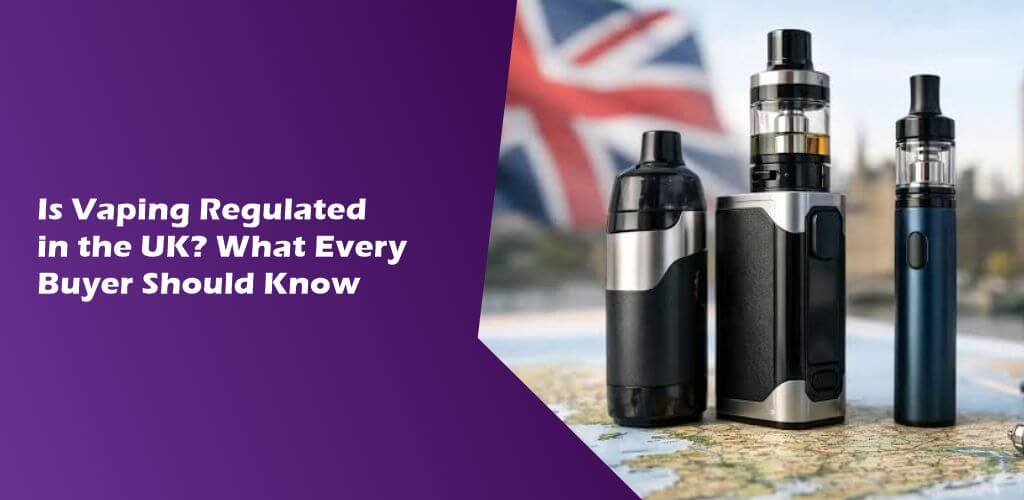
If you have ever stood in front of a shelf of e-liquids and wondered whether what you are buying is actually legal, you are not alone. Vaping sits at an unusual crossroads in the UK. It is promoted by public health bodies as a route away from smoking, yet it is also one of the most tightly monitored consumer product categories on the market.
So, is vaping regulated in the UK? Yes, thoroughly. From nicotine strength and bottle size to packaging, advertising and who is allowed to buy a device in the first place, UK vaping regulations cover almost every stage of the product journey. This guide walks through exactly what the law says today, what changed with the disposable vape ban, what the new Tobacco and Vapes Act means for buyers, and how to make sure every product you purchase is fully compliant. Whether you are new to vaping or switching from disposables to a refillable setup, you will finish this article knowing precisely what to look for before you buy.
Is Vaping Legal in the UK?
Vaping is legal in the UK for adults aged 18 and over. It is recognised by the NHS and public health authorities as a significantly less harmful alternative to smoking, and it is actively used as part of stop-smoking support across the country. Legality, however, does not mean an absence of rules.
Every vape liquid, device and disposable sold in the UK must meet requirements set out under UK vaping regulations, primarily the Tobacco and Related Products Regulations (TRPR), which is the UK’s implementation of the EU Tobacco Products Directive (TPD) retained after Brexit. On top of this sits newer legislation, including the ban on single-use disposable vapes and the Tobacco and Vapes Act 2026, which introduces further controls on marketing, retail licensing and youth access.
In short: vaping itself is legal, but only compliant, correctly labelled, age-restricted products can be lawfully sold. This is precisely why buying from an established, transparent UK retailer matters. It removes the guesswork and the legal risk from the equation entirely.
What Are the Latest UK Vaping Regulations?
UK vape laws have moved quickly over the past two years, and buyers should understand the current framework rather than relying on outdated information from a few years ago.
The Disposable Vape Ban
Since 1 June 2025, it has been illegal for any UK business to sell, supply, or hold for sale single-use disposable vapes, including nicotine-free versions. A device only qualifies as legal today if it is rechargeable, refillable and has a coil or pod that can be replaced. This single change reshaped the entire vaping products UK market, pushing manufacturers and retailers towards reusable pod systems and refillable kits.
The Tobacco and Vapes Act 2026
The Tobacco and Vapes Bill received Royal Assent on 29 April 2026, becoming the Tobacco and Vapes Act 2026. While its headline measure is a generational tobacco sales ban starting 1 January 2027, the Act also brings in vaping-specific reforms, including:
- A formal retailer licensing and registration scheme for tobacco and vape sales
- Tighter restrictions on vape advertising, sponsorship and promotional displays
- New enforcement powers for Trading Standards, including fixed penalty notices
- Continued restriction on flavour naming and packaging designed to appeal to under-18s
Most of the under-18 sale offences, proxy purchase bans and free-distribution restrictions are expected to commence in late 2026, with wider advertising rules following in 2027. Buyers should expect vape legislation UK to keep evolving over the next two to three years as these provisions are phased in.
A New Vaping Products Duty
From 1 October 2026, a new Vaping Products Duty of £2.20 per 10ml of e-liquid will apply, regardless of nicotine strength, with retailer registration opening from 1 April 2026. This is a taxation change rather than a safety regulation, but it will affect pricing across the vape liquid market, making it more important than ever to buy from retailers who price transparently and absorb compliance costs responsibly.
Who Can Legally Buy Vaping Products in the UK?
The legal vaping age UK-wide is 18. This applies uniformly across England, Scotland, Wales and Northern Ireland, and it covers every category of vaping product, including nicotine-free e-liquids, devices, and replacement pods.
Retailers are legally required to verify age before completing a sale. Under UK vape rules, this typically means:
- Requesting valid photo ID (passport, driving licence, or a recognised proof-of-age scheme card) for anyone who appears under 25
- Refusing sale where age cannot be confirmed
- Applying the same verification standard online as in person, including at the point of delivery in many cases
Proxy purchasing, buying vape products on behalf of someone under 18, is also an offence. As enforcement powers expand under the Tobacco and Vapes Act, penalties for retailers who fail age verification checks are becoming more severe, including potential sales bans of up to a year for repeat breaches. At KLiquid, robust age verification is built into the checkout process, because compliance protects genuine adult customers as much as it protects young people.
Are Disposable Vapes Regulated Differently?
Yes, disposables now sit under a completely separate legal category. Before June 2025, single-use vapes were regulated in the same way as any other TPD-compliant product: nicotine strength limits, bottle sizes and labelling rules applied, but the devices themselves could still be sold.
That has changed. Under current disposable vape regulations:
| Product Type | Legal Status | Requirements |
| Single-use disposable vapes | Banned from sale and supply | Cannot be sold since 1 June 2025 |
| Rechargeable, refillable pod kits | Legal | Must meet TPD/TRPR standards |
| Prefilled pods with replaceable coils | Legal | Must meet TPD/TRPR standards |
| Vape liquid sold separately | Legal | Bottle size, nicotine limit and labelling rules apply |
The practical effect for buyers is straightforward: if a device cannot be recharged and its consumable part cannot be refilled or replaced, it is not legally available in the UK anymore. This has driven strong demand for refillable pod systems paired with high-quality vaping liquid, which now offer the same convenience disposables once did, without the legal or environmental drawbacks.
How Does the TPD Affect Vape Products in the UK?
The Tobacco Products Directive, now enforced in the UK through the Tobacco and Related Products Regulations, remains the foundation of product-level vape compliance. TPD vape regulations control nearly every technical aspect of what can legally be sold, including:
- Maximum nicotine strength
- Maximum bottle and tank sizes
- Ingredient restrictions
- Child-resistant and tamper-evident packaging
- Mandatory health warnings and labelling
- Pre-market notification to the regulator
Any product that fails to meet these standards cannot legally be sold in the UK, regardless of where it was manufactured. This is one of the clearest signals of a compliant retailer: every SKU on the site should be traceable to a valid MHRA notification.
MHRA Notification Requirements
Before any nicotine-containing vape product can be sold in the UK, the manufacturer or importer must submit a notification to the Medicines and Healthcare products Regulatory Agency (MHRA). This submission includes full ingredient lists, emission data, and toxicological information. Once approved, the product receives a notification reference that is publicly searchable.
This step exists precisely so that vape safety standards are independently verified before a product ever reaches a shop shelf. When a retailer talks about “MHRA-notified” e-liquids, this is what they mean, and it is a strong indicator of legitimate, compliant vaping products UK-wide.
What Ingredients Are Permitted in UK Vape Liquids?
Ingredient transparency is one of the more overlooked parts of UK vape regulations, but it matters enormously for consumer safety. Under TRPR, permitted e-liquid ingredients are restricted to a defined list, generally limited to:
- Propylene glycol (PG) and vegetable glycerine (VG) as base liquids
- Nicotine, where included, at regulated concentrations
- Approved flavourings that have passed toxicological assessment
- Purified water, where used in the formulation
Certain substances are explicitly banned from e-liquids sold in the UK, including colourings, caffeine, taurine, and any ingredient linked to respiratory harm when inhaled. Every batch of vape liquid should also be accompanied by full ingredient disclosure, both on the packaging and, ideally, through additional detail available from the retailer.
This is one of the areas where buying premium, UK-compliant vaping liquid genuinely matters. Grey-market imports frequently fail to meet these ingredient standards, which is a real safety risk rather than a technicality.
What Nicotine Limits Exist in the UK?
Nicotine vape regulations UK-wide cap the maximum strength of any e-liquid at 20mg/ml. This limit applies across the whole market, whether the product is a nicotine salt formulation or a traditional freebase e-liquid.
Alongside the strength cap, physical container rules also apply:
- Bottle size: E-liquid containing nicotine cannot be sold in bottles larger than 10ml
- Tank capacity: Vape tanks and pod reservoirs are capped at 2ml capacity for nicotine-containing liquid
These limits were originally designed to reduce the risk of nicotine overexposure and to discourage excessive, unregulated refilling. For buyers, the takeaway is simple: any nicotine e-liquid sold in a bottle larger than 10ml, or a tank holding more than 2ml, is not compliant with UK law, no matter how it is marketed.
Nicotine-free vape liquid is not subject to the same strength cap, since there is no nicotine content to limit, but it still must meet the same ingredient, labelling and packaging standards as any other product.
How Can Buyers Identify Compliant Vaping Products?
With so many products circulating online, knowing how to spot a genuinely compliant item protects both your safety and your wallet. Here is a practical checklist:
- Check for MHRA notification. Reputable products reference their notification status, and this can be cross-checked against the MHRA’s public product register.
- Look for child-resistant, tamper-evident packaging. This is a legal requirement for all nicotine-containing e-liquid, not an optional safety extra.
- Confirm nicotine strength and bottle size. Nicotine e-liquid should never exceed 20mg/ml or come in bottles over 10ml.
- Read the label for full ingredient disclosure. Compliant vape liquid clearly lists PG/VG ratio, nicotine content, and flavourings used.
- Verify age checks at checkout. A retailer that does not ask for ID verification is not meeting UK vape rules.
- Avoid unusually cheap disposable-style devices. Since these can no longer be legally sold, extremely low-priced “disposable” listings are a red flag for non-compliant stock.
Buying vape liquid UK-wide from an established retailer with a transparent compliance process removes almost all of this risk from the buyer’s side.
Consumer Safety and Responsible Vaping Practices
Regulation covers what can be sold, but responsible use still depends on the buyer. A few practical habits make a genuine difference to vaping safety:
- Store vape liquid out of reach of children and pets, in its original child-resistant packaging
- Avoid mixing e-liquids from unverified or unlabelled sources
- Replace coils and pods according to manufacturer guidance to avoid degraded flavour or overheating
- Charge devices using the cable supplied or a compatible, quality-checked alternative
- Choose nicotine strength based on your previous smoking habits, and step down gradually if your goal is to reduce nicotine intake over time
The NHS and other public health bodies continue to position vaping as a substantially lower-risk alternative to smoking for adult smokers, while being clear that it is not risk-free and is not intended for non-smokers or under-18s.
Why Buy Vape Liquid and Vaping Liquid from a Reputable UK Retailer Like KLiquid
With UK vape laws tightening year on year, where you buy matters just as much as what you buy. KLiquid exists to take the uncertainty out of that decision. Every product listed is sourced with full compliance in mind, from MHRA notification through to correct nicotine strength, bottle size and labelling.
When you choose to buy vape liquid or vaping liquid through KLiquid, you get:
- Full compliance with TPD/TRPR nicotine and packaging standards on every product
- Transparent ingredient information, so you know exactly what you are inhaling
- Strict age verification at checkout, protecting both customers and the wider community
- A curated range built around genuine quality rather than short-term trends
- Ongoing awareness of regulatory changes, including the disposable vape ban and the incoming Vaping Products Duty, reflected honestly in pricing and product availability
This is the difference between a retailer that treats compliance as a footnote and one that builds it into every part of the buying experience.
Key Takeaways
- Vaping is legal in the UK for adults aged 18 and over, but every product must meet strict compliance standards.
- Single-use disposable vapes have been banned from sale since 1 June 2025; only rechargeable, refillable devices remain legal.
- The Tobacco and Vapes Act 2026 introduces retailer licensing, tighter advertising rules and stronger enforcement powers.
- Nicotine e-liquid is capped at 20mg/ml, in bottles no larger than 10ml, with tanks limited to 2ml capacity.
- All nicotine-containing vape products must carry a valid MHRA notification and child-resistant packaging.
- Buying vape liquid from a compliant, transparent UK retailer is the simplest way to avoid legal and safety risks.
Frequently Asked Questions
Is vaping regulated in the UK?
Yes. Vaping is legal for adults 18 and over, but every product sold must comply with UK vaping regulations covering nicotine strength, bottle size, ingredients, packaging and labelling.
What is the legal vaping age in the UK?
The legal vaping age UK-wide is 18. Retailers must verify age before selling any vaping product, including nicotine-free e-liquids.
Are disposable vapes still legal in the UK?
No. Since 1 June 2025, single-use disposable vapes cannot legally be sold or supplied anywhere in the UK. Only rechargeable, refillable devices remain on the market.
What is the maximum nicotine strength allowed in UK e-liquids?
Under current nicotine vape regulations UK, the maximum permitted strength is 20mg/ml, sold in bottles no larger than 10ml.
What does the TPD mean for vape products?
The Tobacco Products Directive, enforced in the UK via TRPR, sets the rules for nicotine strength, tank capacity, ingredient restrictions, labelling and MHRA notification.
How do I know if a vape product is MHRA-notified?
Compliant products reference their notification status, which can be checked against the MHRA’s public product notification register.
Is it legal to buy vape liquid online in the UK?
Yes, provided the retailer verifies your age and the products meet TPD/TRPR standards, buying vape liquid online is fully legal.
What is changing with the Tobacco and Vapes Act 2026?
The Act introduces a retailer licensing scheme, stronger advertising restrictions, expanded enforcement powers, and a generational tobacco sales ban from 1 January 2027, alongside continued vaping-specific reforms through 2026 and 2027.
Ready to Shop with Confidence?
Understanding UK vape compliance should not fall entirely on the buyer. At KLiquid, every bottle of vape liquid and vaping liquid on the site is chosen and checked with UK regulations at the centre of the process, so you can focus on finding the flavour and strength that suits you. Browse KLiquid’s range of premium, fully compliant e-liquids today and experience what responsible, quality-first vaping should feel like.