
The difference between nicotine-free and nicotine e-liquids comes down to one ingredient. Nicotine-free e-liquid contains no nicotine and is labelled 0mg. Nicotine-containing e-liquid includes nicotine at a stated strength, up to 20mg/ml in the UK. That single ingredient changes the throat sensation, the potential for dependence, the packaging rules and the legal category of the product.
This guide compares nicotine-free vs nicotine e-liquid in practical terms: ingredients, nicotine strength, throat hit, dependence, label reading and current UK rules, including changes that took effect in October 2026. It is written for adults who already vape or use nicotine products. Vaping is not for children or for adults who have never smoked.
What Are Nicotine-Free and Nicotine E-Liquids?
A nicotine-free e-liquid, also called nicotine-free vape juice or 0mg nicotine e-liquid, contains no added nicotine. A nicotine-containing e-liquid contains nicotine at a declared concentration in milligrams per millilitre (mg/ml). Both turn into vapour in a device, and both can taste identical on the label.
“0mg” and “nicotine-free” mean the same thing on a product label. Neither term means risk-free. Inhaling any aerosol carries uncertainty, which the safety section below covers.
What ingredients do e-liquids contain?
Nicotine e-liquid ingredients and nicotine-free vape liquid ingredients overlap almost completely:
- Propylene glycol (PG): a thin carrier that carries flavour well and adds a mild throat sensation.
- Vegetable glycerine (VG): a thicker, slightly sweet carrier that produces denser vapour.
- Flavourings: food-grade flavour concentrates that give each liquid its taste.
- Nicotine: present only in nicotine-containing products, in the form of freebase nicotine or nicotine salts.
The PG/VG ratio describes the balance between the two carriers. A 70/30 blend contains 70% PG and 30% VG. KLiquid’s own e-liquid listings, including its K Liquid and Cloud 9 bottles, state a 70/30 PG/VG mix with pharmaceutical grade nicotine.
What Is the Main Difference Between Nicotine-Free and Nicotine E-Liquids?
The main difference is that nicotine-containing e-liquid delivers nicotine, a substance that can cause dependence, and falls under tighter UK product law. Nicotine-free e-liquid delivers flavour and vapour only, with no nicotine exposure, and sits outside the main vaping product rules. The table sets out the practical contrasts.
| Feature | Nicotine-free e-liquid | Nicotine-containing e-liquid |
| Nicotine content | 0mg/ml | Declared strength, up to 20mg/ml in the UK |
| Dependence potential | No nicotine dependence from the liquid itself | Nicotine is addictive and can cause dependence |
| Throat sensation | Mild, driven mainly by PG and flavouring | Stronger, with nicotine adding its own harshness |
| Core ingredients | PG, VG, flavourings | PG, VG, flavourings, nicotine |
| Main UK product rules | General product safety and chemicals law | Tobacco and Related Products Regulations (TRPR) |
| MHRA notification | Not required under TRPR | Required before sale |
| Bottle size limit | No TRPR limit on size | 10ml maximum per refill container |
| Nicotine warning labels | Not required by TRPR | Required |
Two questions come up often. First, does nicotine-free e-liquid contain any nicotine? A product sold as 0mg should contain none as an added ingredient. Second, can nicotine-free e-liquid cause nicotine addiction? Without nicotine, the liquid cannot cause nicotine dependence, although habitual behaviour around vaping can still form.
How Does Nicotine Strength Affect the Vaping Experience?
Nicotine strength tells you how much nicotine each millilitre of liquid contains. A strength of 18mg means 18 milligrams of nicotine per millilitre, which equals 1.8%. Higher strengths deliver more nicotine per puff and usually feel stronger in the throat. Strength alone does not decide flavour quality, vapour volume or which device suits you.
What do common nicotine strength labels mean?
Nicotine strengths in e-liquid appear in a few familiar steps. These examples illustrate how labels scale and do not describe any particular retailer’s stock:
- 0mg: nicotine-free (0%)
- 3mg: 0.3%
- 6mg: 0.6%
- 12mg: 1.2%
- 18mg: 1.8%
- 20mg: 2%, the UK legal maximum
Comparing 0mg vs 3mg e-liquid shows the smallest step from nicotine-free to a low strength. Comparing 0mg vs 6mg e-liquid shows a larger jump, and the sensation usually changes more noticeably. People who already use nicotine often choose a strength based on their existing intake, because moving between very different strengths can feel unfamiliar.
Does nicotine-free e-liquid produce a throat hit?
Yes, to a lesser degree. Throat hit in e-liquids comes from several sources. PG contributes a gentle tickle, cooling agents such as menthol add a sharp sensation, and nicotine adds a distinct peppery harshness. A 0mg liquid with a high PG content and a menthol flavour can still feel crisp in the throat. A nicotine-containing version of the same flavour usually feels sharper.
What is the difference between nicotine salts and freebase nicotine?
Nicotine salts vs freebase nicotine describes two chemical forms of nicotine. Freebase nicotine is the traditional form and tends to feel harsher as strength rises. Nicotine salts combine nicotine with an acid, which many users find smoother at the same strength. Product labels and manufacturer descriptions should state which form a liquid uses. Nicotine-free liquid contains neither.
Does nicotine change the flavour of e-liquid?
Nicotine has a taste of its own, often described as slightly bitter or peppery. Because of this, a nicotine-free and a nicotine version of one flavour may taste a little different, even when the flavouring recipe matches. Nicotine-free and nicotine-containing versions can share a flavour profile without being identical in composition or in how they taste.
Are Nicotine-Free E-Liquids Safer Than Nicotine E-Liquids?
Nicotine-free e-liquid removes nicotine exposure and the risk of nicotine dependence from the liquid. It does not remove every risk. Vaping any liquid involves inhaling heated PG, VG and flavourings, and researchers still lack long-term data on the effects. Nicotine-free vaping is not completely safe, harmless or medically recommended.
Public health bodies take a consistent position. UK government messaging states that vaping is less harmful than smoking and can help adult smokers quit, but that it is not risk-free. Children and adults who have never smoked should not vape. Cancer Research UK adds that long-term health effects remain unknown.
It helps to separate the risks:
- Nicotine-related risks: dependence, and effects on young people whose brains are still developing.
- Other vaping-related risks: effects from inhaling aerosol, device quality, and the heating of liquids, which affect nicotine-free products as well.
- Evidence gaps: long-term outcomes for both nicotine-free and nicotine vaping lack decades of data.
This article does not diagnose, recommend treatment or promise that any product helps someone stop smoking. Adults who want support to stop smoking can speak to a GP, pharmacist or local stop smoking service.
What Are the UK Rules for Nicotine-Free and Nicotine-Containing E-Liquids?
Are nicotine-free e-liquids regulated in the UK? Yes, but not under the same framework as nicotine products. Nicotine-containing e-liquids fall under the Tobacco and Related Products Regulations 2016 (TRPR), overseen by the MHRA. Nicotine-free e-liquids sit outside TRPR and fall under general product safety and chemicals rules instead. Several newer rules cover both types.
Rules that apply to nicotine-containing e-liquids
Under the UK Tobacco and Related Products Regulations, nicotine-containing products must meet these requirements:
- Maximum nicotine strength of 20mg/ml
- Maximum refill container size of 10ml
- Maximum tank capacity of 2ml
- Child-resistant and tamper-evident packaging
- Ingredient lists and health warnings on the packaging
- Notification to the MHRA, and publication, before the product goes on sale
- A ban on certain ingredients, including colourings, caffeine and taurine
Rules for nicotine-free e-liquids
MHRA retailer guidance states that 0% nicotine e-liquids fall outside the scope of TRPR. General product safety law and chemicals legislation, such as CLP and REACH, still apply. This is why nicotine-free “short-fill” bottles can come in larger sizes than the 10ml TRPR limit. Always check that any product you buy comes from a reputable UK supplier with clear labelling.
Recent changes that affect both product types
Several changes under the Tobacco and Vapes Act 2026 and related tax rules now cover nicotine-free products too:
- Age of sale (from 29 October 2026): Nicotine-free vapes were not previously covered by age-of-sale rules. The ban on selling them to under 18s now applies across the UK. Adults also commit an offence if they buy a vaping or nicotine product on behalf of someone under 18.
- Promotions (from 29 October 2026): The government has prohibited promotional giveaways and substantial promotional discounts in shops and online, and has banned vending machine sales of vapes.
- Vaping Products Duty (from 1 October 2026): A flat rate of £2.20 per 10ml applies to all vaping liquids, whether or not they contain nicotine. Products made or imported from that date need a duty stamp, and from 1 April 2027 all retail packaging must carry a valid stamp.
- Still to come: The government is considering restrictions on flavours, packaging and displays, and intends an advertising and sponsorship ban from 1 June 2027. Check official guidance for updates.
How Can Adults Compare Nicotine-Free and Nicotine E-Liquids Before Buying?
Start with the label. Check the nicotine strength, the PG/VG ratio, the bottle size and the ingredient list, then confirm the product suits your device. Choosing the right e-liquid depends on matching these details to your existing habits, never on starting nicotine. Nobody who does not already use nicotine should begin.
How can you read nicotine strength labels?
Learning how to read nicotine strength labels takes a minute. Look for a figure followed by “mg” or “mg/ml”, such as 18mg. A bare “0mg” or “0%” means nicotine-free. Nicotine-containing products must also carry a health warning, which gives a second quick check. A product with no clear strength on the label should not go in your basket.
What should you check before you buy?
- Nicotine concentration: confirm the exact figure, especially if you are moving between strengths or between nicotine-free and nicotine versions.
- PG/VG ratio: a higher PG blend suits many standard devices, while very thick high-VG liquids can struggle in some of them.
- Ingredients: read the full list and avoid anything unfamiliar.
- Packaging: look for child-resistant caps and clear manufacturer details.
- Device compatibility: check the manufacturer’s guidance for your device.
Quality matters here, and a supplier that publishes full product details makes it easier. When you compare premium e-liquids, look for transparent specifications rather than slogans. Shoppers can browse premium e-liquids at KLiquid, a UK e-liquid supplier whose e-liquid products carry stated pack sizes and strengths.
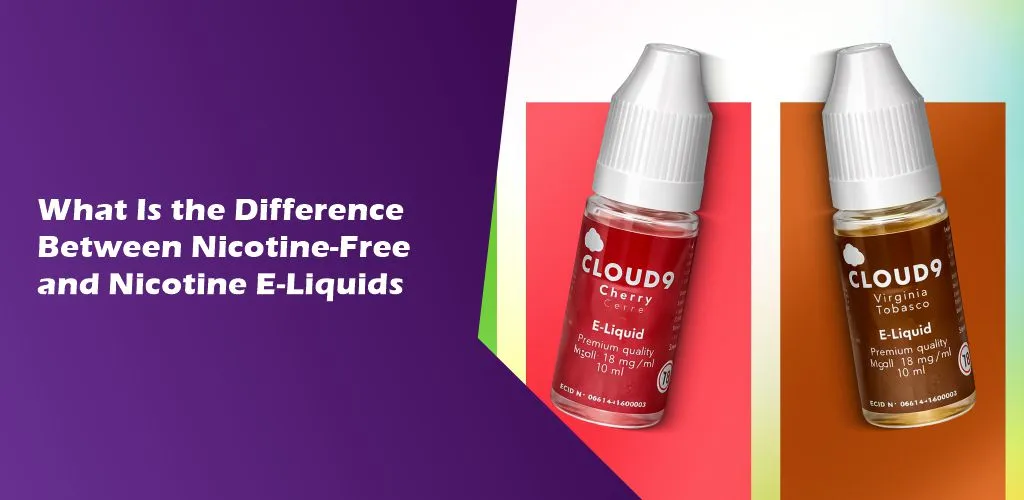
KLiquid’s current e-liquid range lists 10ml bottles and multi-bottle boxes in flavours including menthol, tobacco, cherry, apple, blueberry and strawberry. The K Liquid and Cloud 9 listings state an 18mg nicotine strength, a 70/30 PG/VG blend and child-proof caps, and they carry an 18+ age restriction.
Frequently Asked Questions
What is a short-fill e-liquid?
A short-fill is a nicotine-free liquid sold in a larger, partly filled bottle. Because it contains no nicotine, TRPR’s 10ml limit does not apply to it.
Can any e-liquid go in any device?
Not always. Thicker, high-VG liquids can wick poorly in some devices, so follow your device maker’s guidance on PG/VG ratio.
Conclusion
The difference between nicotine-free and nicotine e-liquids is the nicotine itself. Nicotine-free e-liquid has 0mg, no nicotine dependence from the liquid and a milder throat sensation. Nicotine-containing e-liquid carries a stated strength up to 20mg/ml, can cause dependence and falls under TRPR, with MHRA notification, a 10ml bottle limit and mandatory warnings. Both share PG, VG and flavourings, and both now fall under the October 2026 age-of-sale and duty changes.
Adults who already vape can find verified product information, strengths and specifications at KLiquid, where the e-liquid range lists clear details for each listing. Vaping products are for adults aged 18 and over only, and they are not recommended for non-smokers.
Sources used for regulatory statements: GOV.UK MHRA e-cigarette and vape guidance, MHRA advice for retailers and producers, GOV.UK press release “Under-18 sales ban extended to nicotine products and all vapes” (29 October 2026), and HMRC and GOV.UK guidance on Vaping Products Duty.